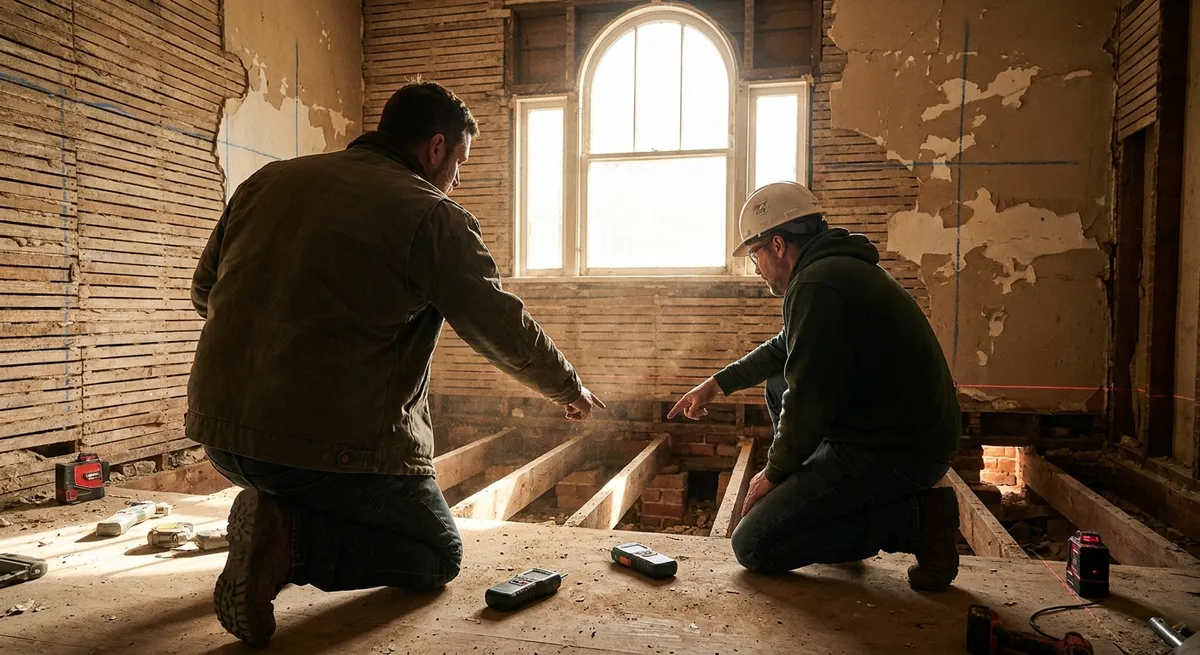
1. Start With a Forensic Assessment, Not a Shopping List
Professionals don’t jump straight to “what to install”; they begin with “what’s really happening in this structure.”
A proper forensic assessment looks at how the house actually behaves under load, weather, moisture, and time. This means mapping out not only visible damage but also the hidden systems that support or threaten your home.
Key steps you should follow:
- Document existing conditions thoroughly
Take high‑resolution photos and videos of every room, attic, basement/crawlspace, mechanical room, and exterior elevations. Capture close‑ups of cracks, stains, rust, warped materials, and questionable repairs. Label them by room and date.
- Track movement and moisture over time, not just in the moment
Use painter’s tape and a fine marker to date and outline cracks in drywall or plaster. Re‑check monthly to see if they grow. Invest in a basic moisture meter and map readings around windows, exterior doors, bathrooms, laundry areas, basement walls, and below grade surfaces.
- Inspect critical structural and envelope areas
- Attic: Look for sagging roof sheathing, darkened or moldy rafters, compressed insulation, daylight gaps at eaves, and any signs of ice damming.
- Foundation: Check for stair‑step cracks in masonry, horizontal cracks in poured concrete, bulging walls, or efflorescence (white, chalky deposits—sign of moisture migration).
- Framing: In basements or crawlspaces, probe floor joists and sill plates with an awl to test for rot; look for insect damage (powder, channels, frass).
- Bring in the right specialists early
If you see major cracks, settlement, bowed walls, or chronic moisture, get a licensed structural engineer or building envelope specialist involved before any contractor starts demo. Their written report becomes the backbone of a professional‑grade restoration plan.
- Create a “defects and causes” list, not just a punch list
For each issue (e.g., peeling paint, cupped hardwood, musty closet), identify likely underlying causes (bulk water intrusion, high humidity, poor ventilation, foundation movement, failed flashing, undersized gutters, etc.). Professionals repair causes, not just symptoms.
This diagnostic approach shifts your renovation from “updating the look” to strategically restoring performance, safety, and resilience.
2. Prioritize a Dry, Stable Envelope Before Any Interior Upgrades
Pros know that a house that can’t manage water and air will destroy any cosmetic upgrade you put inside it—sometimes in a single season. That’s why the building envelope (roof, walls, windows, doors, foundation, and air/vapor barriers) gets priority.
Focus on controlling water in all its forms:
- Start at the top: roof and flashing
- Inspect or have inspected all roof penetrations (chimneys, vents, skylights). Failed flashing is a leading cause of chronic leaks and hidden rot.
- Check shingle condition, missing tabs, granule loss, and soft spots in sheathing when walked (only by qualified personnel with fall protection).
- Ensure kick‑out flashing where rooflines meet walls—missing kick‑outs can channel water behind siding for years before it’s visible indoors.
- Move to the sides: siding, trim, and openings
- Replace or repair damaged siding, rotted trim, and failed caulk joints.
- Verify that window and door head flashings are present and properly lapped. Retrofit if needed.
- If re‑siding, upgrade to a modern water‑resistive barrier (WRB) and integrate window flashing tapes per manufacturer specs and local code.
- Control bulk water at grade
- Ensure a minimum 6-inch clearance between soil and siding.
- Re‑grade away from the foundation, aiming for 5% slope (about 6 inches over 10 feet) where possible.
- Extend downspouts at least 4–6 feet away from the foundation or tie into a properly designed drainage system.
- Address basement and crawlspace moisture the professional way
- Seal obvious foundation cracks and joints with appropriate materials (epoxy injection for structural cracks, polyurethane sealants or hydraulic cement for non‑structural openings, as recommended by a professional).
- Install or repair perimeter drains and sump systems if you have recurring water intrusion.
- In crawlspaces, install a continuous vapor barrier on soil, seal vents (in many climates), and consider conditioned or semi‑conditioned crawlspace designs per building‑science guidance.
Only after the envelope is reasonably dry and airtight should you move forward with major interior finishes like flooring, built‑ins, or high‑end millwork. Otherwise, you’re installing expensive materials in a failure‑prone environment.
3. Upgrade Mechanical Systems With a Performance Mindset, Not Just Code Minimum
Professionals see mechanical systems—HVAC, electrical, and plumbing—as the infrastructure that protects your building envelope and finishes, not just utility hookups. Code sets the minimum; long‑term performance calls for better.
HVAC: right‑sizing and air quality
- Have a qualified HVAC designer or contractor perform a proper Manual J load calculation instead of replacing equipment “like for like.” Over‑ or under‑sized systems lead to uneven temperatures, poor humidity control, and shortened equipment life.
- Whenever possible, choose sealed combustion appliances (furnaces, boilers, water heaters) to reduce back‑drafting and indoor air quality risks.
- Integrate mechanical ventilation in tighter homes—either a dedicated ERV/HRV or a balanced, code‑compliant ventilation strategy. This helps control humidity, odors, and pollutants that can damage finishes and occupant health.
Electrical: safety and capacity for modern loads
- Replace outdated panels (especially fused or known problematic brands) with modern breaker panels sized for current and anticipated load (EV chargers, workshop tools, future additions).
- Ensure ground fault circuit interrupter (GFCI) and arc fault circuit interrupter (AFCI) protection where required—and consider going beyond minimum code in older homes for added safety.
- During restoration, run additional circuits and conduit where access is easy. It’s far cheaper now than after walls are closed and surfaces are finished.
Plumbing: leak prevention and serviceability
- Replace aging galvanized or polybutylene lines with PEX or copper (as permitted and appropriate in your jurisdiction). Target sections that run through finished areas first—hidden pipe failures cause the most costly damage.
- Plan accessible shutoffs for all major fixture groups and appliances. Pros think in terms of “how fast can I isolate a problem when something fails?”
- Where feasible, design mechanical rooms and vertical chases so that future repairs or replacements don’t require tearing apart finished spaces.
By approaching mechanical systems as part of a performance ecosystem rather than “utilities in the background,” you prevent the kind of slow, hidden failures that turn small repairs into full‑scale restorations later.
4. Select Materials and Assemblies for Your Climate, Not Just Their Look
Homeowners often choose finishes and building materials by appearance and price. Professionals start with climate, exposure, and maintenance profile, then narrow options based on aesthetics and budget.
Match exterior materials to environmental realities
- In wet or freeze‑thaw climates, avoid low‑quality composite trims and unback‑primed wood on vulnerable details (rake boards, window trim ends, skirt boards). Specify factory‑primed/factory‑finished products or highly rot‑resistant species (e.g., fiber cement, PVC trim, or properly detailed metal cladding) where abuse is highest.
- In hot, sunny climates, account for UV load and thermal expansion. Dark paints on south‑ and west‑facing facades can drastically shorten coating life and increase substrate movement.
Detail assemblies, not just products
Professionals think in terms of systems:
- Siding + WRB + flashing + ventilation gap (rainscreen)
- Tile + backer board + waterproofing membrane + movement joints
- Flooring + underlayment + vapor control + subfloor type
For example, in a shower remodel, they won’t simply “add cement board and tile.” Instead, they’ll:
- Choose a proven, fully waterproofed shower system (sheet membrane or liquid‑applied, per manufacturer specs).
- Slope all surfaces toward the drain at the right pitch.
- Integrate corners, niches, and transitions with compatible waterproofing components.
- Use movement joints and appropriate grout and sealants for the specific tile and substrate.
Consider maintenance cycles explicitly
When selecting any finish—roofing, siding, decking, flooring—document:
- Expected service life under your climate and exposure
- Recommended maintenance intervals (repainting, re‑sealing, cleaning)
- Consequences of deferred maintenance (cosmetic only vs. structural risk)
Pros often favor slightly higher initial cost for materials that fail gracefully and give clear warning signs before causing structural damage (e.g., some types of claddings and roofing versus bare, unprotected wood in harsh exposures).
5. Sequence Work Like a Pro to Avoid Re‑Work and Hidden Conflicts
Even excellent individual repairs can fail if executed out of order. Professional restoration projects live or die on sequencing—who does what, and when.
Think from structure out, and from dirty to clean
A typical pro‑level sequence on a serious restoration might look like:
Stabilization and safety
- Temporary shoring of compromised framing or foundations - Asbestos, lead paint, or mold assessment and abatement where necessary - Utility shutoffs or safe temporary setups
Structural and envelope corrections
- Foundation repairs, structural framing corrections, roof system reinforcement - Exterior envelope work: roofing, flashing, WRB, windows/doors, siding corrections - Major penetrations for vents, ducts, and future mechanicals
Rough‑in of mechanical, electrical, and plumbing (MEP)
- Route all new runs while framing is accessible - Coordinate mechanical pathways to avoid notching or boring critical structural members - Conduct pressure tests, inspections, and corrections before closing walls
Insulation, air sealing, and envelope testing (where feasible)
- Air seal top plates, rim joists, penetrations, and major junctions - Install insulation appropriate to climate and assembly type - If practical, perform blower‑door testing now to identify major leakage paths
Interior finishes and detail work
- Drywall, trim, doors, cabinetry, flooring, tile—done in an order that protects the most delicate surfaces - Final painting and coatings last, after all high‑risk trades are done
Avoid common amateur sequencing mistakes
- Installing new drywall or finishes before fixing exterior moisture intrusion.
- Putting down finished flooring before heavy mechanical equipment is set or major appliances are moved.
- Painting early, then repeatedly touching up due to ongoing trades and inspections.
- Closing ceiling cavities before finalizing lighting, ventilation, or sprinkler layouts.
Create a written scope and sequence for your project, even if you’re managing multiple smaller contractors. Treat this as your master document and adjust it only deliberately, understanding the downstream effects of any change. This is how professionals keep restorations from turning into a series of expensive do‑overs.
Conclusion
Expert‑level home restoration isn’t about fancy tools or trendy finishes; it’s about the discipline to think like a building scientist and a general contractor at the same time. Start with a forensic assessment instead of a wish list. Make the building envelope dry and stable before chasing interior upgrades. Treat mechanicals as a performance engine, not an afterthought. Choose materials as part of climate‑specific assemblies, not decor. And sequence every phase so that each step reinforces—not undermines—the last.
When you approach your renovation with this structural‑first, systems‑oriented mindset, your home doesn’t just look restored; it behaves like a resilient, efficient, and safe structure for years to come. That’s the difference between a project that photographs well today and a home that still performs a decade from now.
Sources
- U.S. Department of Energy – Building Envelope Guidance - Explains principles of air sealing and envelope performance that underpin durable restorations.
- U.S. Environmental Protection Agency – Moisture Control Guidance - Detailed strategies for managing moisture in buildings to prevent damage and mold.
- Building America Solution Center (U.S. DOE) - Technical guides on building assemblies, HVAC, and durability practices used by professionals.
- International Association of Certified Home Inspectors – Structural Issues - Overview of common structural problems and professional inspection considerations.
- ASHRAE – Residential Ventilation and IAQ - Professional standards and guidance on mechanical ventilation and indoor air quality.