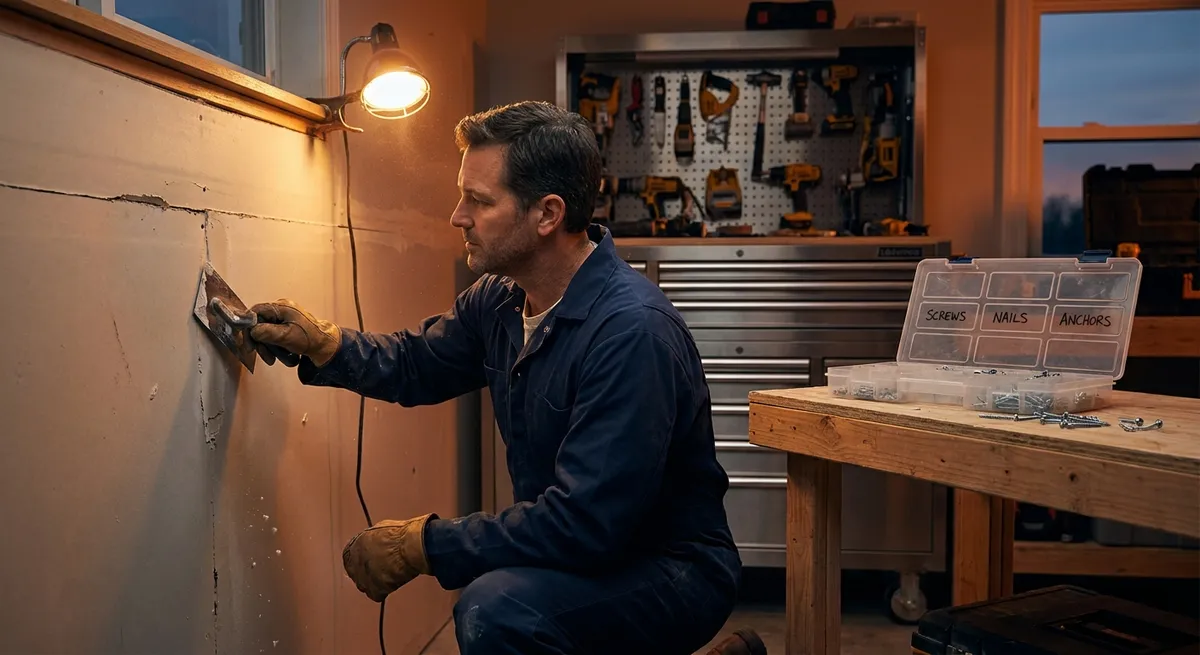
Start Every Repair With a Forensic Assessment, Not a To‑Do List
Professionals never start with the hammer; they start with the diagnosis. The more time you spend understanding exactly why something failed, the less time and money you’ll spend fixing it again later.
Begin by mapping the failure, not just the visible damage. For water issues, track stains in three dimensions: roof/upper walls, mid‑walls, and floor level. Note the pattern (linear, circular, or diffuse). Linear stains often trace pipes or roof seams; circular stains may indicate a localized penetration like a fastener or a point leak.
Use multiple senses. A musty odor with no visible mold often points to hidden moisture in insulated cavities. A hollow sound when tapping tile can indicate bond failure or substrate movement. An infrared thermometer or basic moisture meter—both affordable homeowner tools—can quickly show you where temperature or moisture readings break the pattern of adjacent areas.
Document everything before you open a wall or pull a floor: wide shots, close-ups, and notes of when symptoms appear (after rain, only in winter, when HVAC runs). This “forensic” record helps you avoid chasing the wrong cause, and it’s invaluable if you need to coordinate with insurance, trades, or future contractors. Only after you’ve traced the problem back to its source—whether that’s a failed flashing, undersized gutter, missing vapor barrier, or movement in the structure—should you define the actual scope of repair.
Respect the Assembly: Match Materials to How the House Was Built
Professional restorers don’t just pick “good” materials; they match materials to the assembly—how layers of structure, insulation, air barrier, and finishes work together. A well-intentioned upgrade in the wrong place can trap moisture, cause cracking, or shorten the life of nearby components.
For example, when repairing exterior walls in older homes built without modern vapor barriers, jumping straight to a fully impermeable siding or housewrap can prevent the wall from drying to the exterior. In many climates, what you actually want is a controlled pathway for moisture to escape. That may mean using a permeable housewrap, adding a rainscreen gap behind siding, or choosing a breathable paint instead of an acrylic membrane on masonry.
Floor repairs demand the same respect. If you’re patching a wood subfloor over a crawlspace or basement, match thickness, orientation, and grade. Mixing plywood with OSB, or changing thickness in a small area without blocking and support, can create a “hinge” in the floor—exactly where tiles crack or new squeaks develop. When in doubt, add blocking and fasteners that extend at least one joist bay beyond the patch area.
Even small repairs like replacing a few roof shingles benefit from assembly thinking. Confirm underlayment type (synthetic vs felt), exposure lines, and nail pattern. Replacing shingles without respecting the underlayment laps and fastener placement can be worse than leaving a minor cosmetic defect in place. Pros would rather carefully dismantle and rebuild a small section correctly than force in a “close enough” patch.
Control Water in All Three States: Liquid, Vapor, and Airborne
Most major home failures trace back to water—but not always in the way homeowners expect. Professional restoration treats water management as a three-part system: bulk water, water vapor, and condensation from air movement. Effective repairs look at all three.
Bulk water is the obvious one: roof leaks, overflowing gutters, failed flashing, and plumbing breaks. The pro move is to build redundancy. A window, for example, should have properly lapped flashing tape, a sloped sill pan, and a drainage path to the exterior. If one component fails, the others buy you time. When repairing water-damaged windows or doors, don’t just reseal the exterior; evaluate whether a sill pan or head flashing is missing and add it.
Water vapor moves through materials and air. When repairing bathrooms, laundry areas, or basements, treat any opened walls as an opportunity to improve vapor and air control. Make sure bath fans vent outdoors (never to an attic or soffit), properly seal duct penetrations, and use appropriate moisture-resistant backer boards and membranes in wet zones. In cold climates, avoid placing impermeable materials on the wrong side of the wall where they can trap vapor.
Condensation from air leaks is one of the most overlooked culprits, especially in attics and rim joists. Warm, moist indoor air escaping into a cold attic or exterior wall cavity can condense and soak insulation and framing without a single “leak” from outdoors. When repairing ceilings, can lights, or attic access hatches, use gaskets, sealed housings, airtight drywall techniques, and proper insulation coverage. The repair you see (a stained ceiling) often starts as unseen air leakage higher up.
Anchor Repairs to Structure, Not Just to Surfaces
Durable repairs transfer loads back into the structure. Surface-only fixes may look neat but will often fail at the first significant stress—movement, weight, or temperature swing. Pros are constantly asking: “Where does this load really go?”
When reinforcing sagging floors, for instance, sistering joists is more effective when new members extend significantly beyond the damaged area and bear on proper supports, not just on hangers or nails near midspan. If subfloor patches span cut joists or large openings, add framing below to recreate solid bearing points, not just rely on the old, compromised members.
In wall repairs, avoid attaching heavy items (cabinets, large TVs, barn doors, grab bars) solely to drywall or questionable blocking. If a wall is open for repair, future-proof it: add full-height or strategically placed blocking at standard mounting heights. Think about shear and pull-out forces—especially in areas subject to vibration (near doors, garages, or stairs) or sudden loads (handrails, safety bars).
Exterior repairs are just as structural. When fixing deck rot, for example, pros evaluate ledger attachments, post footings, beam sizing, and lateral bracing, not just replace the visibly rotten boards. A deck that “only feels a bit bouncy” may be signaling undersized joists, corroded connectors, or inadequate lateral tie-downs. Use proper structural connectors, stainless or hot-dipped galvanized fasteners rated for outdoor and treated lumber use, and follow manufacturer span and load tables. A cosmetically perfect deck with marginal structure is a known failure pattern in residential construction—and an avoidable one.
Treat Every Opened Area as a Chance to Upgrade Safety and Efficiency
Professional restorers don’t just put things back; they look for economical improvements that are only feasible when components are already open. This mindset dramatically increases the long-term value of every repair dollar you spend.
Electrical access is a prime opportunity. If a wall or ceiling is open for any reason, have a qualified electrician assess wire condition, junction box fill, grounding, and GFCI/AFCI protection in that run. Upgrading undersized boxes, correcting splices, and adding in-line protection is far easier and cheaper now than after the wall is closed. Replace any damaged or cloth-insulated wiring, and make sure bathroom, kitchen, laundry, and exterior circuits meet current safety standards.
Thermal and air upgrades are just as important. When repairing exterior walls, rim joists, or attic hatches, improve insulation and air sealing to modern performance levels, even if the rest of the home is older. Use spray foam or carefully installed cut-and-cobble foam board with sealant around penetrations; back it up with proper thermal insulation sized for the cavity. In basements, choose insulation types that tolerate occasional moisture (such as rigid foam with appropriate fire protection), instead of stuffing fiberglass directly against concrete.
Don’t ignore health and code triggers. If you discover lead paint, asbestos-containing materials (like some old floor tiles, mastics, or pipe insulation), or suspect mold during a repair, stop and reassess. Professional-grade work means containing dust, following local regulations for hazardous materials, and sometimes bringing in certified remediation. The “cheap” path—grinding, sanding, or breaking contaminated materials without protection—creates lingering hazards that cost much more to remediate later.
Finally, use documentation as an upgrade tool. Photograph framing, plumbing, wiring, and insulation before closing walls or ceilings. Label photos by room and wall orientation. This “X-ray” archive makes future troubleshooting, repairs, and renovations exponentially more precise and far less invasive.
Conclusion
Durable restoration work isn’t about having the biggest tool collection or the fanciest finishes; it’s about adopting the mindset and methods that professionals rely on every day. Start with a forensic assessment instead of a rushed fix. Respect how your house is assembled before choosing materials. Treat water management as a system, not a caulk joint. Anchor every repair back into the structure, and view opened areas as strategic opportunities to upgrade safety and efficiency.
When you approach repairs this way, your home doesn’t just recover from damage—it steadily evolves into a more resilient, healthier, and more valuable version of itself.
Sources
- U.S. Environmental Protection Agency – Moisture Control Guidance for Building Design, Construction and Maintenance (PDF) - In-depth discussion of moisture, building assemblies, and strategies to prevent mold and structural damage
- U.S. Department of Energy – Air Sealing Your Home - Practical guidance on controlling air leaks around the home to improve durability and efficiency
- Building America Solution Center – Building Envelope Guides - Technical details on wall, roof, and foundation assemblies, flashing, and water management from a building-science perspective
- FEMA – Homeowner’s Guide to Retrofitting (PDF) - Strategies for making homes more resilient to hazards, with emphasis on structural improvements and water management
- Occupational Safety and Health Administration (OSHA) – Lead in Construction - Official safety standards and best practices for working safely around lead-containing building materials