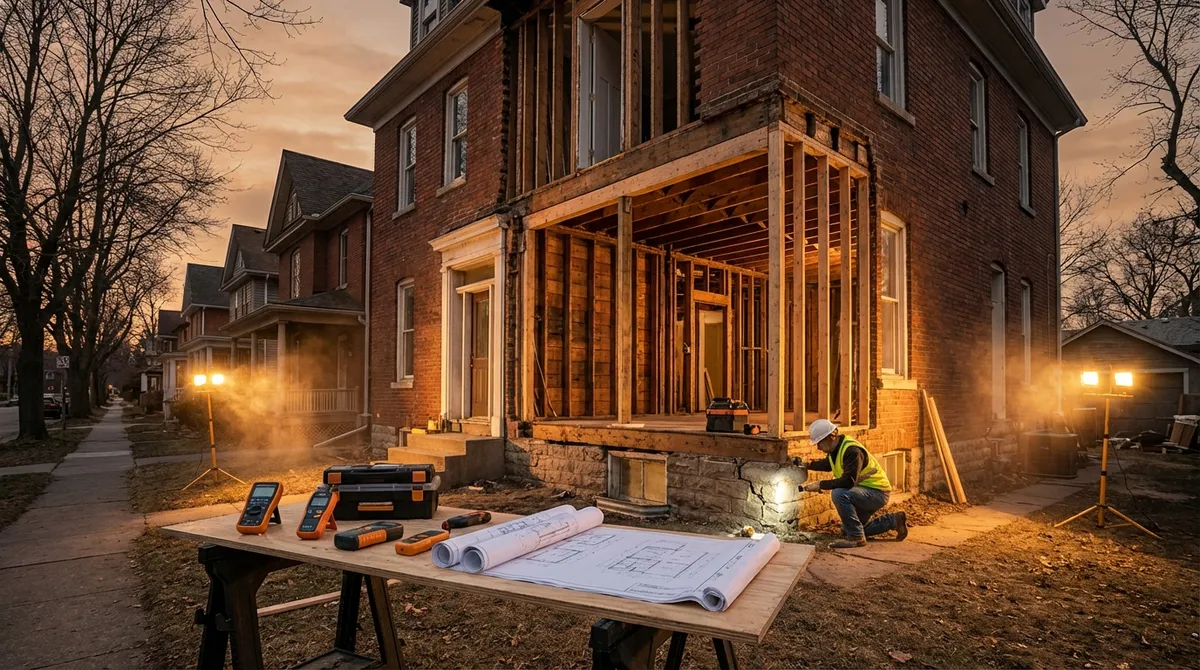
Start with the Building Shell, Not the Kitchen
Most homeowners start where they spend time: kitchens, baths, and living spaces. Restoration professionals start somewhere else—the building shell (roof, walls, foundation, windows, doors). The reason is simple: your finishes are only as durable as the envelope that protects them.
A healthy building shell manages water, air, and thermal movement. If the roof is suspect, the siding is failing, or the foundation is damp, every dollar you pour into interiors is at risk. Before committing to cabinetry, tile, and paint schemes, take a hard, technical look at how your home handles the elements.
Tip 1 – Repair Water and Air Leaks Before Any Aesthetic Work
Water and uncontrolled air movement are the two fastest ways to destroy a restoration. Professionals treat leak control as non-negotiable and front-loaded:
- Inspect the roof and flashings: Look for lifted shingles, rusted or missing flashing around chimneys, skylights, and vents, and any signs of past patchwork. Poor flashing details are a far more common failure point than roofing material itself.
- Probe windows and doors: Check for soft or spongy areas in sills and trim, fogged double-pane glass, failed caulking, and staining around interior jambs. These all signal bulk water intrusion.
- Seal the big air leaks first: Attic penetrations, recessed lights, open chases, gaps around plumbing stacks, and chimney surrounds are notorious for air leakage that drives moisture into assemblies.
- Fix drainage, then finishes: Confirm that gutters and downspouts are functional and discharging water away from the foundation. Regrade soil if necessary. Finishing basements before resolving drainage is one of the most expensive mistakes you can make.
- Prioritize continuous control layers: Think in terms of continuous water, air, and thermal barriers that wrap the house. Interrupted or patchwork solutions almost always cost more later.
By attacking water and air issues first, you protect every future dollar you invest in framing, insulation, and finishes.
Let the House Diagnose Itself: Data-Driven Restoration
Experienced restorers don’t rely on guesswork; they measure. Moisture readings, blower-door tests, and thermal imaging reveal failures you cannot see, allowing you to fix root causes instead of just symptoms.
Moisture trapped in walls, hidden air leaks, and uneven insulation leave signatures—if you know where and how to look. This diagnostic step often transforms the scope of a project, but it also prevents repeated failures.
Tip 2 – Use Professional Testing to Guide Your Scope
Before closing up walls or committing to major systems work, consider targeted diagnostics:
- Blower door testing: A fan depressurizes the house while a technician measures air changes per hour. This reveals leakage pathways and helps prioritize air sealing. Lower leakage usually equals better comfort, durability, and lower energy bills.
- Infrared (IR) thermography: Used during or immediately after a blower door test, IR cameras highlight cold spots where insulation is missing or where air is infiltrating. This is particularly valuable in older homes with complex framing.
- Moisture mapping: Pin and pinless moisture meters can identify hidden damp zones in floors, walls, and trim. High moisture content in wood or drywall is a strong indicator of active leaks or poor ventilation.
- Duct leakage testing (if you have forced air): If you’re restoring a home with existing ductwork, testing can show whether conditioned air is being lost into attics, crawl spaces, or wall cavities, undermining comfort and wasting energy.
- Combustion safety checks: For homes with gas or oil appliances, a professional should confirm that restoration work doesn’t create unsafe backdrafting conditions when the envelope gets tighter.
These diagnostics cost money up front but often save far more by honing your scope. Instead of replacing “everything just in case,” you can surgically target the assemblies and systems that actually fail.
Structure First: Respect Load Paths and Materials
Every restoration decision interacts with structure, even if you’re “just removing a wall” or “raising the ceiling a bit.” The way loads travel from roof to foundation is not always obvious, especially in older homes with multiple renovations. Cutting, notching, or removing structural members without understanding load paths is one of the most dangerous DIY mistakes.
Similarly, combining modern materials with historic assemblies requires more than aesthetic sensitivity; it demands an understanding of how different materials manage moisture, expansion, and aging.
Tip 3 – Align Structural Changes with the Original Load Path
When professionals plan structural modifications, they work from the top down and the bottom up to ensure loads stay continuous and well-supported:
- Identify load-bearing elements before demo: Look for joists overlapping on a wall, perpendicular attic framing over walls, stacked walls from floor to floor, and beams that rest on posts or masonry. When in doubt, assume a wall is bearing until proven otherwise by a qualified pro.
- Work with structural engineers for anything beyond cosmetic: Removing or shortening beams, opening large wall spans, adding a second story, or significantly widening windows and doors should be engineered. This is not an area for guesswork or “it’s probably fine.”
- Respect original materials: Balloon framing, timber framing, and early platform framing all behave differently. Don’t blindly apply modern framing rules to historic assemblies; details like fire blocking, sistering joists, and anchoring methods may need to be adapted.
- Plan support sequences carefully: If you’re replacing a main beam, changing floor systems, or straightening a sag, temporary shoring must be installed in a precise sequence. Jacks should be adjusted slowly over days or weeks to avoid cracking finishes and stressing the structure.
- Choose compatible repair materials: For masonry and plaster restoration, use materials with similar vapor permeability and strength to the original. For example, pairing hard modern cement mortars with soft historic bricks can accelerate spalling and damage.
If a contractor downplays the need for structural review when making major changes, that’s a red flag. An expert restoration starts by ensuring that everything above is properly supported and everything below can carry the load.
Manage Moisture and Air from the Inside Out
Once the envelope and structure are sound, the next layer of professional thinking focuses on how the interior environment behaves: humidity, ventilation, and temperature gradients. These factors are central to mold prevention, indoor air quality, and material longevity.
A common misconception is that “tight houses trap moisture,” when in reality, unmanaged moisture and inadequate ventilation cause problems. A well-restored home is both tightly controlled and properly ventilated.
Tip 4 – Balance Tightness with Ventilation and Humidity Control
Professionals aim for a controlled building, not a leaky one. The strategy includes:
- Targeted mechanical ventilation: Instead of relying on random drafts, pro restorers often specify a balanced or exhaust-based ventilation system sized to the home. This might involve a heat-recovery ventilator (HRV), energy-recovery ventilator (ERV), or high-performance bath and kitchen fans with set run-times.
- Appropriate humidity ranges: Aim to keep indoor relative humidity roughly in the 30–50% range, adjusted seasonally. Prolonged high humidity fosters mold and dust mites; overly dry air can damage woodwork and cause comfort issues. Dehumidifiers may be vital in basements and humid climates.
- Bathroom and kitchen discipline: Exhaust fans should vent outdoors (never into attics or crawl spaces). Sizing, duct layout, and termination location matter. In kitchens, a properly ducted range hood dramatically reduces moisture and pollutants from cooking.
- Smart insulation and vapor control: Insulation type and placement should be matched to climate and wall/roof assembly. In cold climates, vapor control is typically on the interior side; in hot-humid climates, you must avoid creating a vapor trap that drives moisture into cooled assemblies.
- Conditioned basements and crawl spaces: Unmanaged crawl spaces and damp basements are a prime source of moisture and air quality problems. Professional restorations often encapsulate crawl spaces, manage bulk water at the perimeter, and bring these spaces into the conditioned envelope where appropriate.
The core idea: make your home resist unwanted water and air, then introduce the right amount of fresh air on your terms.
Sequence Like a Pro: Plan for Access, Trades, and Future Work
Even the best technical decisions can be undermined by poor sequencing. Professionals think in terms of access (what has to be open), dependencies (which work must precede other work), and future-proofing (what you might need access to later).
Incorrect sequencing can double your costs. For example, insulating and closing a ceiling before verifying roof integrity, or installing high-end flooring before heavy structural work, almost guarantees rework.
Tip 5 – Lock in a Trade-Smart Sequence Before You Spend Big
Create a detailed work order that follows professional logic instead of “room by room” convenience:
- Outside-in, top-down, then inside: Roof, exterior drainage, and structural corrections come before insulation and drywall. HVAC, electrical, and plumbing rough-ins come before insulation. Only once rough-ins are inspected and approved do you close walls.
- Cluster invasive work together: If you know mechanical upgrades, rewiring, and plumbing modernization are on your 5–10 year horizon, consider doing the disruptive portions of that work in a single restoration phase. This avoids repeatedly opening finished surfaces.
- Plan chases and access panels: Create dedicated chases for major duct runs, plumbing stacks, or main electrical feeders. Install access panels where valves, junctions, and key connections exist, rather than burying everything behind finished materials.
- Coordinate trades early: Have your GC or project lead bring HVAC, electrical, and plumbing pros into the planning phase. Their input can prevent conflicts like a duct run blocking a structural reinforcement or a plumbing stack landing in the middle of a future stair opening.
- Document everything: Photograph open walls, floors, and ceilings with measurements before closing them. Store plans, specs, and photos in a shared digital folder. This “as-built” record is invaluable for future repairs, renovations, or inspections.
When you think like a professional, your restoration becomes a long-term strategy, not a series of disconnected projects.
Conclusion
Restoration that stands the test of time is built on a simple hierarchy: keep water out, control air movement, protect structure, manage interior conditions, and only then perfect the finishes. The five professional tips embedded in this approach—fixing leaks before aesthetics, using diagnostics, aligning structural changes with load paths, balancing tightness with ventilation, and sequencing work like a pro—aren’t flashy, but they’re exactly what separates durable, low-maintenance homes from money pits.
For homeowners and investors alike, adopting this building-first mindset turns restoration into an asset-building strategy instead of a cycle of repeated repairs. When you treat your home as an interconnected system and respect the order of operations, every design choice and upgrade sits on a stable, dry, and well-engineered foundation.
Sources
- U.S. Department of Energy – Energy Saver: Air Sealing Your Home – Explains the importance of controlling air leaks and outlines best practices for sealing a home’s envelope.
- U.S. Environmental Protection Agency – Moisture Control Guidance for Building Design, Construction and Maintenance (PDF) – Comprehensive technical guidance on moisture management and mold prevention in buildings.
- Building America Solution Center – Building Envelope Guides – DOE resource with detailed, research-based details for roofs, walls, foundations, and HVAC integration in residential buildings.
- National Park Service – Preservation Briefs – Authoritative series on appropriate methods for restoring and rehabilitating historic building materials and assemblies.
- Harvard Joint Center for Housing Studies – Improving America’s Housing Reports – Research reports providing data-driven insights into home improvement trends, costs, and best practices.